by Daniel Brouse
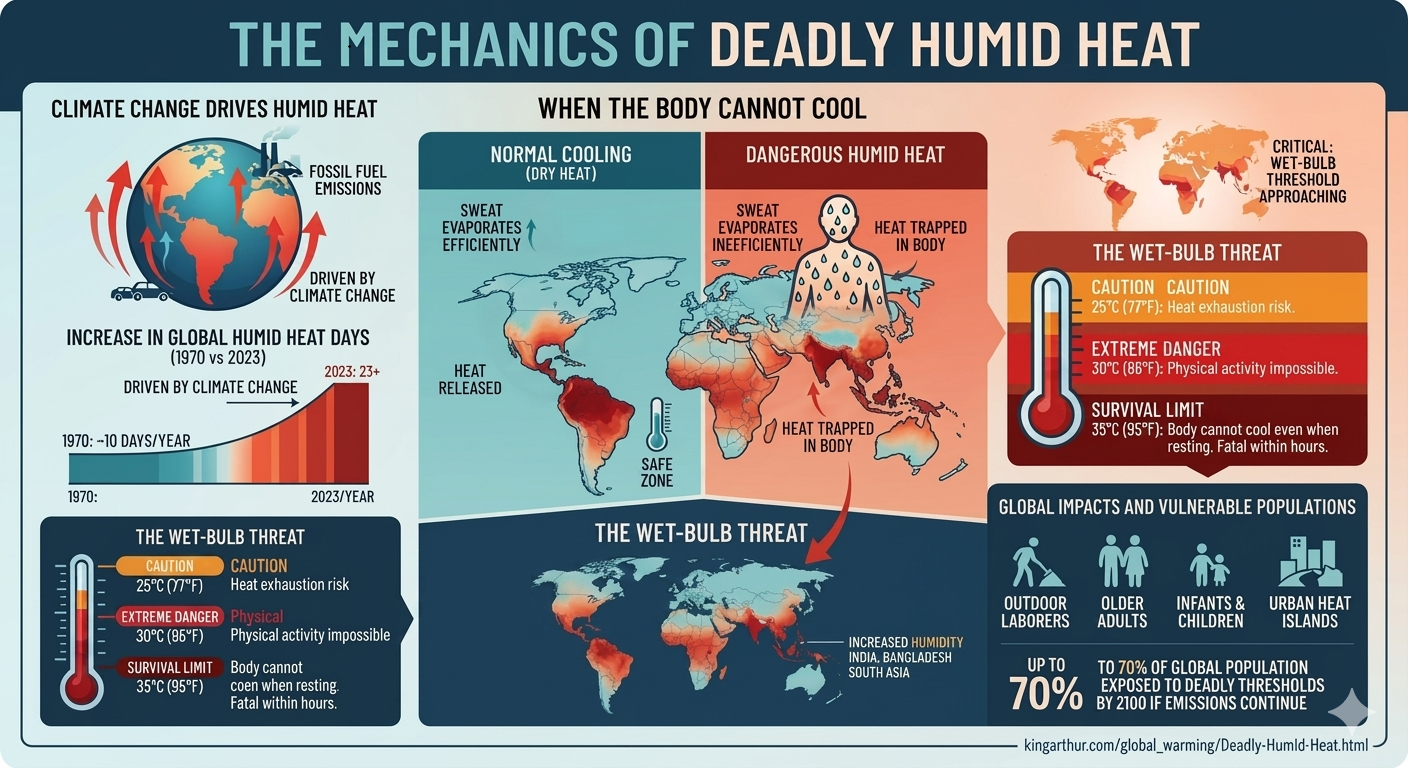
The most immediate and severe health risk from climate change is not heat alone, but the combined effect of heat and humidity—known as wet-bulb temperature. This metric is increasingly recognized as a critical limit on human survivability under climate change and is already becoming dangerous in parts of the world experiencing extreme heat events.
As global temperatures rise, the atmosphere can hold more water vapor. This relationship is governed by the Clausius–Clapeyron equation, which indicates that saturation water vapor capacity increases by roughly 6–7% per 1°C of warming. This intensifies humidity, reducing the effectiveness of sweat-based cooling and increasing physiological heat stress.
Wet-bulb temperature is measured using a thermometer wrapped in a wet cloth, simulating the body's evaporative cooling system. When humidity is high, evaporation slows, limiting the body’s ability to dissipate heat. If environmental heat and humidity exceed what the human body can compensate for, core temperature begins to rise uncontrollably.
A widely cited theoretical upper bound for human survivability is a wet-bulb temperature of 35°C (95°F) under idealized conditions (shade, airflow, hydration, and healthy individuals). However, more recent physiological and climate-chamber studies suggest that real-world tolerance is often significantly lower, particularly under sustained exposure or physical exertion.
Importantly, these thresholds are not absolute “cliff edges,” but represent zones where thermoregulation begins to fail depending on duration, physiology, and environmental context.
These findings refine—but do not overturn—the earlier 35°C benchmark. Instead, they highlight that dangerous physiological stress can occur well before theoretical limits are reached.
Beyond these thresholds, the body may be unable to maintain stable core temperature even in shaded and ventilated environments. Symptoms include fatigue, confusion, rapid heart rate, dizziness, and ultimately heat stroke. In extreme cases, sustained exposure without cooling access can become fatal within hours.
Heat stress is increasingly understood not simply as dehydration or discomfort, but as a systemic physiological burden affecting multiple organ systems simultaneously, including:
This shifts heatwaves from being viewed as isolated weather events to being recognized as multi-system biological stress events with direct mortality implications.
Emerging biomedical research indicates that elevated environmental heat can amplify systemic inflammation and interfere with normal immune regulation. Heat stress increases physiological load on cellular repair mechanisms and may exacerbate oxidative stress.
Laboratory and epidemiological studies suggest that prolonged or repeated heat exposure may contribute to:
While research is ongoing, there is growing evidence that heat stress acts as a “multiplier” of existing health vulnerabilities rather than a single isolated risk factor.
These effects are especially pronounced in urban environments where nighttime cooling is reduced and exposure is prolonged across consecutive days or weeks.
The increasing frequency of extreme heat is strongly linked to broader climate system changes, including:
As the climate system warms, the atmosphere not only becomes hotter, but also more humid in many regions—intensifying wet-bulb risk conditions.
This combination increases the likelihood of prolonged heat events that persist through both daytime and nighttime periods, limiting physiological recovery.
Humidity plays a central role in heat mortality risk because human cooling depends primarily on evaporation of sweat.
As humidity rises:
This is why moderately warm but highly humid conditions can be more dangerous than higher dry-bulb temperatures.
Risk becomes especially severe when:
Under these conditions, the body may be unable to recover from cumulative heat load.
Heat is already one of the leading causes of weather-related mortality globally, but its impact is often undercounted because deaths are frequently attributed to cardiovascular, respiratory, or renal failure rather than heat as the underlying cause.
As warming continues, more regions are expected to periodically approach or exceed dangerous wet-bulb thresholds, particularly during heatwaves combined with high humidity.
Populations most at risk include:
This makes heat not only an environmental issue, but a direct and escalating public health constraint.
As temperatures rise, societies become increasingly dependent on cooling systems, especially air conditioning. However, this creates interconnected stresses across infrastructure systems:
This creates a reinforcing feedback loop:
more heat → more cooling demand → higher energy use → increased emissions (in fossil-based systems) → further warming
Breaking this cycle requires both rapid emissions reductions and improved energy efficiency and adaptation strategies.
Ultimately, human physiological heat limits are becoming a central constraint that climate policy, infrastructure design, and public health planning must increasingly account for in the 21st century.
Crossing the Heat Threshold: Wet-Bulb Temperatures Signal a Climate Turning Point
Wet-Bulb Temperatures in the US
Evaporation: Death by Corn Sweat
Burning to Stay Cool: How Our Fight Against Heat Is Fueling Climate Collapse
* Our probabilistic, ensemble-based climate model — which incorporates complex socio-economic and ecological feedback loops within a dynamic, nonlinear system — projects that global temperatures are becoming unsustainable this century. This far exceeds earlier estimates of a 4°C rise over the next thousand years, highlighting a dramatic acceleration in global warming. We are now entering a phase of compound, cascading collapse, where climate, ecological, and societal systems destabilize through interlinked, self-reinforcing feedback loops.
We examine how human activities — such as deforestation, fossil fuel combustion, mass consumption, industrial agriculture, and land development — interact with ecological processes like thermal energy redistribution, carbon cycling, hydrological flow, biodiversity loss, and the spread of disease vectors. These interactions do not follow linear cause-and-effect patterns. Instead, they form complex, self-reinforcing feedback loops that can trigger rapid, system-wide transformations — often abruptly and without warning. Grasping these dynamics is crucial for accurately assessing global risks and developing effective strategies for long-term survival.
The Climate Crisis: Violent Rain | Deadly Humid Heat | Health Collapse | Extreme Weather Events | Insurance | Trees and Deforestation | Soil | Rising Sea Level | Food and Water